Stages of Embryo Development During In-Vitro Fertilization (IVF)
Published: 12/11/2015
Fertilization occurs in 4-6 hours in humans, but there are no visible signs until approximately 17-18 hours later.
The first signs of fertilization are the development of two round bodies in the center of the egg. The slightly smaller body is the female pronucleus which contains 23 chromosomes that the egg contributes to the embryo. The other round body is the male pronucleus which contains the contribution of 23 chromosomes from the sperm. The egg must be checked at this point for fertilization because, over the next 6 hours or so, the two pronuclei come together in a process known as syngamy (where the two pronuclei join chromosomes) forming one nucleus of 46 chromosomes.
Within the next 6 hours (30 hours from fertilization), the now "fertilized egg" will divide, producing a 2-cell embryo. Further division (or "cleavage") takes place every 10-12 hours, producing a 4-cell embryo on day 2, an 8-cell embryo on day 3, a morula or ball of too many cells to count on day 4, and a blastocyst on day 5.
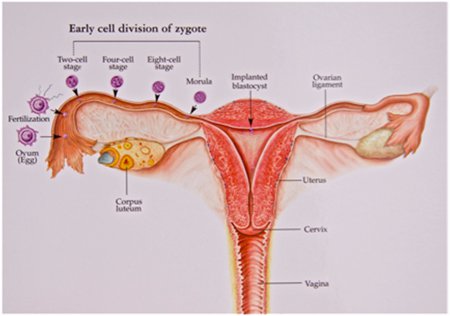
A graphic representation of the different stages of embryo development; from either the release of an egg at ovulation or recovery of eggs during In-Vitro Fertilization (IVF) to fertilization inside the fallopian tube or outside the body by Intracytoplasmic Sperm Injection (ICSI), and to the different stages of embryo development in the fallopian tube or in the Assisted Reproductive Technology (ART) incubator prior to embryo transfer at the 8-cell stage or blastocyst stage.
If the embryo is looked at too late after fertilization, then "abnormal" fertilization can be overlooked and the embryo will "appear normal." This "abnormal" embryo can divide and even implant, but will not produce a viable pregnancy, and is only destined to abort, resulting in a miscarriage and disappointment.
Fertilized Pronuclear Embryo
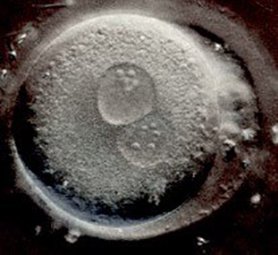
A fertilized pronuclear embryo showing syngamy (or coming together) of the male and female pronuclei at about 24 hours.
Fertilized 2 Cell Embryo
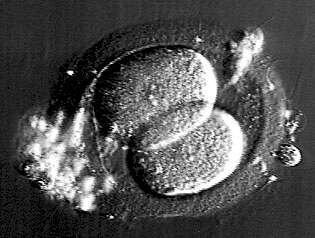
A normal fertilized 2-cell embryo at about 30 hours from egg recovery.
Fertilized 4 Cell Embryo
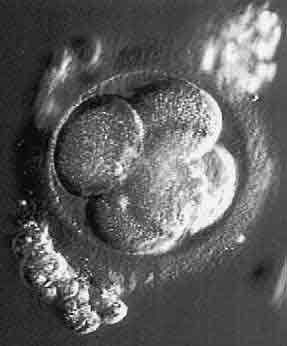
A normal 4-cell embryo on day 2, approximately 48 hours after fertilization.
Fertilized 8 Cell Embryo
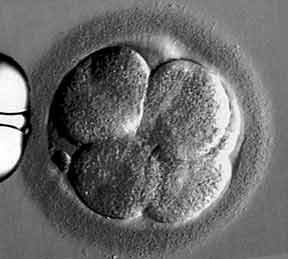
A normal 8-cell embryo on day 3, approximately 72 hours after egg recovery.
Morula
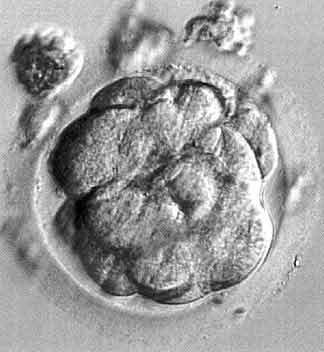
A normal morula on day 4, showing signs of compaction and having too many cells to count.
Blastocyst
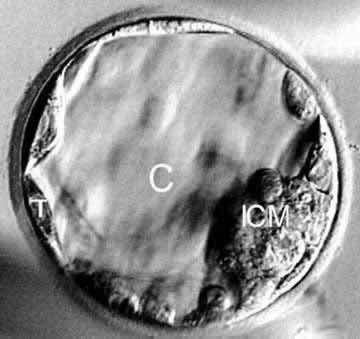
A perfectly normal-looking day 5 blastocyst with an ICM (stem cells where the baby develops from), blastocyst cavity (C), and an outer wall of trophoblastic cells (where the placenta develops from).
Stages of IVF Embryo Development Video

Success Rates
In-Vitro
Fertilization (IVF)



Our Scottsdale Fertility Clinic Location
8426 E Shea Blvd.
Scottsdale, Arizona 85260
Phone: (480) 860-4792
New Patient Referrals Fax: 480-946-9914
Routine Fax: 480-860-6819
Hours:
Monday - Friday: 8:00 AM - 5:00 PM
Saturday – Sunday: Closed
Important Notice:
If you're traveling north via the Loop 101 Pima Freeway towards our clinic, please be aware of significant delays, especially near the Shea Blvd. exit. We recommend allowing extra travel time to ensure you arrive relaxed and on time for your appointment. Your timely arrival helps us provide the best care for you and others. Stay safe and plan ahead!

Our Gilbert Fertility Clinic Location
3885 S. Val Vista Dr.
Ste 105
Gilbert, Arizona 85297
Phone: (480) 860-4792
New Patient Referrals Fax: 480-946-9914
Routine Fax: 480-860-6819
Hours:
Monday - Friday: 8:00 AM - 5:00 PM
Saturday – Sunday: Closed