Fertility Preservation
Fertility Preservation due to Cancer and Other Medical Conditions
Each year, 150,000 Americans under the age of 45 are diagnosed with cancer. Chemotherapy, radiation, and radical surgery, while highly effective against cancer, may also cause irreversible damage to male and female reproductive systems. Thus, many cancer survivors will overcome their life-threatening illnesses only to struggle with infertility.
The loss of testicular, uterine, and ovarian function associated with anti-cancer therapy can be just as emotionally devastating as the initial diagnosis of cancer. Fortunately, survivors do not have to leave their reproductive future to chance. With the cutting-edge fertility preservation services available today, patients facing potentially-sterilizing medical conditions and treatments can protect their future ability to have children. Our specialized team at Arizona Center for Fertility Studies can help. We offer several options for fertility preservation, including:
- Sperm banking
- Egg banking (oocyte vitrification)
- Embryo banking (embryo vitrification)
- Ovarian transposition
- Ovarian tissue freezing (experimental)
- Donor sperm, donor egg, and gestational carrier services
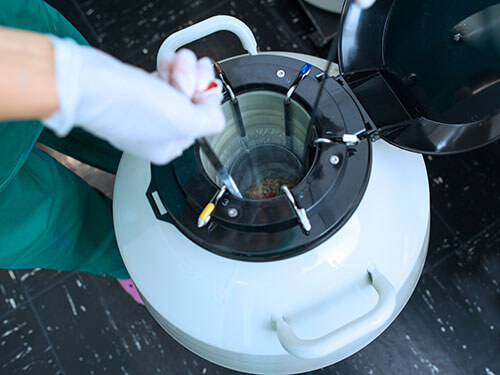
Fertility preservation is safe and effective and can be initiated quickly and seamlessly in close coordination with your oncology team. More often than not, a woman’s eggs or a man’s sperm can be retrieved and frozen, or cryopreserved, prior to suffering any damage. Healthy sperm, eggs, or embryos (created through in vitro fertilization) can, therefore, be cryopreserved, stored for long periods, then successfully thawed to achieve pregnancy through intrauterine insemination (IUI) or in vitro fertilization (IVF) in the future.
We know that fertility preservation is important to you
Although many patients with cancer report anxiety about their ability to have children in the future, relatively few discuss fertility concerns with their healthcare providers. Our first mission is to let you know that you can take control of your reproductive health before, during, and after your cancer care. The majority of patients who desire fertility preservation will have time to bank sperm, eggs, or embryos or to take advantage of surgical fertility preservation options like ovarian transposition or ovarian tissue freezing. For those few who cannot, the information gained by consulting with a reproductive specialist can help explore future family planning options and also for ensuring adequate control of any reproductive side-effects related to cancer treatment, e.g. irregular cycles, hot flashes, or decreased libido.
The fertility preservation team at ACFS is available to ensure that you have answers to your questions about fertility preservation when you need them. We can help you to better understand the effects of cancer treatment on your reproductive function and aid you in finding the optimal course of treatment should you decide to take advantage of our cutting-edge services.
FAQ's
I don’t want to delay my cancer treatment? Will I have enough time to preserve my fertility?
We will schedule any urgent fertility preservation consultation within 24 hours of your request. Sperm banking can be done immediately and at any time. Ovarian transposition and ovarian tissue freezing can be done with laparoscopy as a 1-2 hour same-day surgery with small incisions and a short recovery time. Egg and embryo banking can be done in as little time as 1-2 weeks regardless of where a woman is in her menstrual cycle.
Is fertility preservation safe?
Study data show that patients who undergo fertility preservation are just as likely to survive their cancer as those who did not, but their anxiety levels may be substantially decreased and their quality of life after remission may be vastly improved.
Will I be able to afford it?
We offer specially discounted rates for any fertility-sparing services that are not covered by insurance. We can also help you apply for medication assistance programs, which may cover the cost of fertility drugs for egg and embryo cryopreservation cycles.
I heard that egg freezing is “new” technology. Does it really work?
Yes, in 2012, the American Society for Reproductive Medicine and the Society for Assisted Reproductive Technologies lifted the experimental designation from egg freezing because it proved to be a safe and effective technique. At ACFS, egg vitrification has been a successful component of routine clinical practice for fertility preservation and the treatment of infertile couples for several years. We perform several oocyte freeze/thaws monthly. Nearly 100% of the eggs that we freeze survive the thawing process, fertilize and create normal embryos just as well as their fresh counterparts. Therefore we confidently offer this option to any woman desiring fertility preservation.
Remember that whenever possible fertility-sparing interventions should take place before starting chemotherapy or radiation, so please contact us today for your FREE consultation. We recognize that timing and communication are critical to your success, so we have made a promise to discuss your options with you within 24 hours and to coordinate all care with your oncology team.
In the past, a diagnosis of cancer meant that the goal of having a family may never be reached. Today, we can achieve that goal together. We hope to work with you, your loved ones, and your oncology team to turn your dreams of becoming a parent into a reality.
ACFS is proud to partner with the following organizations to provide support and financial assistance for fertility preservation.




Request Your Consultation
If you want to learn more about fertility preservation, call your ACFS fertility team today at (480) 860-4792.

Success Rates
In-Vitro
Fertilization (IVF)



Our Scottsdale Fertility Clinic Location
8426 E Shea Blvd.
Scottsdale, Arizona 85260
Phone: (480) 860-4792
New Patient Referrals Fax: 480-946-9914
Routine Fax: 480-860-6819
Hours:
Monday - Friday: 8:00 AM - 5:00 PM
Saturday – Sunday: Closed
Important Notice:
If you're traveling north via the Loop 101 Pima Freeway towards our clinic, please be aware of significant delays, especially near the Shea Blvd. exit. We recommend allowing extra travel time to ensure you arrive relaxed and on time for your appointment. Your timely arrival helps us provide the best care for you and others. Stay safe and plan ahead!

Our Gilbert Fertility Clinic Location
3885 S. Val Vista Dr.
Ste 105
Gilbert, Arizona 85297
Phone: (480) 860-4792
New Patient Referrals Fax: 480-946-9914
Routine Fax: 480-860-6819
Hours:
Monday - Friday: 8:00 AM - 5:00 PM
Saturday – Sunday: Closed